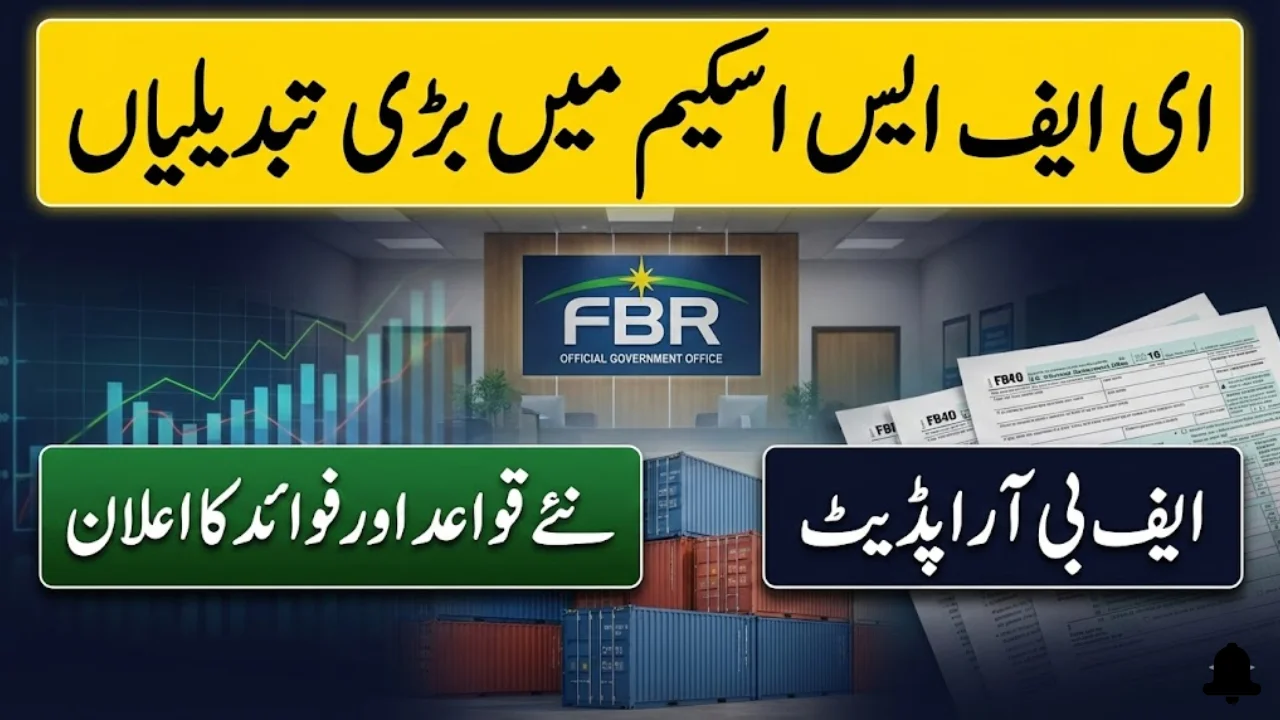
The Federal Board of Revenue has announced new amendments to the Export Facilitation Scheme (EFS), further refining how exporters can import duty-free input goods. The latest update has been issued through an official SRO, signaling continued adjustments to make the scheme more practical for exporters.
The move is being widely searched under the focus keyword fbr efs scheme changes, as exporters assess how the revised rules affect their operations.
What Are the Latest FBR EFS Scheme Changes
Under the newly notified amendments to the Customs Rules, 2001, exporters using the EFS will now be allowed additional flexibility in importing duty-free input goods.
If an exporter:
-
Utilizes part or all of the approved input goods, and
-
Successfully exports the output goods before the allowed utilization period,
then the system will permit fresh duty-free imports equal to the value of inputs already consumed in exported goods.

This allowance, however, is capped at the approved value limit.
Key Conditions Exporters Must Follow
The revised rules come with strict safeguards to avoid misuse:
-
Input and output descriptions must remain unchanged
-
PCT Codes must match those already approved
-
Input-Output Ratios (IORs) must be fully approved
If IORs are not approved or only provisional, exporters will not be eligible for additional duty-free acquisition under this provision.

Role of IOCO and Regulatory Collector
All approvals related to:
-
Input-output coefficients
-
Product descriptions
-
Value limits
must be cleared by the Input Output Coefficient Organization (IOCO) or the Regulatory Collector. Any mismatch or unapproved ratio will block further EFS benefits.
This step strengthens compliance while keeping genuine exporters protected.

Appeal Mechanism Introduced in EFS Rules
Another important update in the fbr efs scheme changes is the formal appeal process.
If an exporter disagrees with an order issued by a Regulatory Collector:
-
An appeal can be filed with the Chief Collector
-
Time limit to file: 30 days
-
Appeal decision timeline: within 30 days
This provides exporters with a faster and clearer dispute resolution pathway.

Why FBR Is Updating the EFS Scheme
The Export Facilitation Scheme is a major tool to:
-
Promote exports
-
Reduce cost of production
-
Improve liquidity for exporters
By refining the rules, FBR aims to balance facilitation with control, ensuring that exporters benefit without revenue leakage.
Common Questions About FBR EFS Scheme Changes
What is the main benefit of the new EFS changes?
Exporters can import additional duty-free inputs after exporting finished goods early.

Do PCT codes need to stay the same?
Yes, both input and output PCT codes must match approved records.
Can exporters apply if IORs are provisional?
No, provisional or unapproved IORs are not eligible.
Is there an appeal option against EFS decisions?
Yes, appeals can be filed before the Chief Collector within 30 days.
Which rules have been amended?
The changes are part of amendments to the Customs Rules, 2001.
Conclusion
The latest fbr efs scheme changes reflect FBR’s continued effort to fine-tune export facilitation while maintaining regulatory discipline. With clearer conditions, added flexibility, and a defined appeal process, the revised EFS rules are expected to improve operational ease for compliant exporters and strengthen confidence in Pakistan’s export framework.