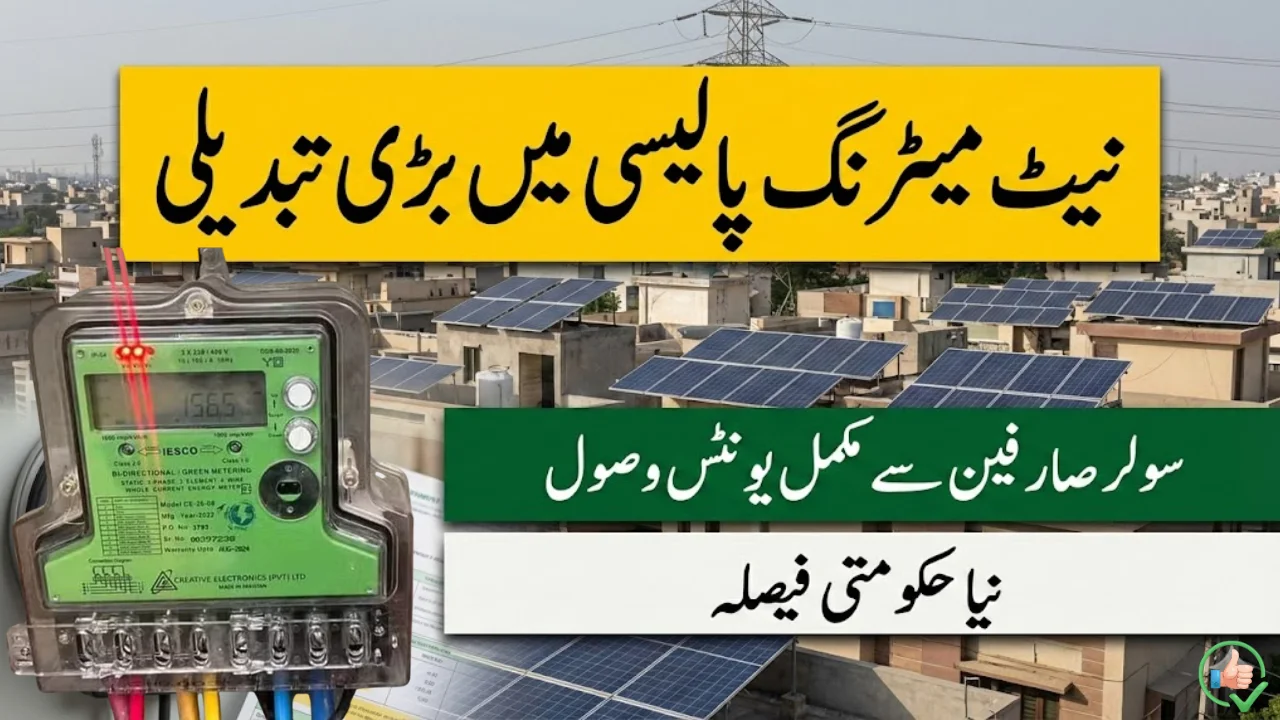
Pakistan’s solar power users are set to face a major shift after the National Electric Power Regulatory Authority notified the Net Metering Regulations 2026. Under the revised policy, the long-standing unit-for-unit adjustment system has been abolished, replacing it with a net billing mechanism.
This change directly impacts residential, commercial, industrial, and agricultural solar consumers across Pakistan. NEPRA has officially ended unit-for-unit net metering, meaning solar consumers will now pay full electricity unit charges in Pakistan.
What Has Changed in Net Metering Policy 2026
Previously, solar users could offset the electricity they consumed with the units they exported to the grid. That system has now ended.
Under the new framework:
-
Solar power exports will be purchased at National Average Energy Price
-
Electricity consumed from the grid will be charged at full applicable tariff
-
Billing will be settled monthly (30-day cycle) based on actual usage and exports

This effectively means solar consumers will pay full unit prices, even if they export electricity to the grid.
Net Billing System Explained (Simple Terms)
Here’s how the new net billing system works:
| Activity | How It’s Charged |
|---|---|
| Electricity used from grid | Full consumer tariff |
| Electricity exported to grid | National Average Energy Price |
| Billing cycle | Monthly |
| Excess units | Paid separately (no adjustment) |
The one-to-one unit compensation model is no longer allowed.
Who Is Covered Under the New Rules
NEPRA has expanded and clarified the scope of eligible consumers:
-
Residential users
-
Commercial setups

-
Industrial consumers
-
Agricultural connections
-
General services consumers
Eligible systems include solar, wind, and biogas installations up to 1 MW, connected at 400V or 11kV, subject to DISCO approval.
Biogas Prosumers Now Included
For the first time, biogas-based power producers have been formally brought under the same regulatory framework. This move aims to standardize all distributed generation under one transparent system.
Net Metering Contract Period Reduced
Another major change under the Prosumer Regulations 2026:

-
Net metering contracts are now limited to 5 years
-
Contracts can be renewed for an additional 5 years upon expiry
-
Automatic long-term continuation is no longer allowed
This gives regulators tighter control over distributed generation agreements.
Net Metering 2015 Regulations Suspended
With the enforcement of the 2026 framework:
-
Net Metering Regulations 2015 stand suspended

-
All new and existing consumers will gradually shift to the new system
NEPRA says the move is aimed at:
-
Improving transparency
-
Aligning tariffs with national power costs
-
Standardizing distributed generation
FAQs People Are Searching Online
Is unit-for-unit net metering still allowed in Pakistan?
No, it has been officially ended under the 2026 regulations.

Will solar users pay full electricity charges now?
Yes, electricity consumed from the grid will be billed at full tariff.
At what rate will exported solar units be purchased?
At the National Average Energy Price.
Does this apply to existing net metering users?
Yes, existing users will transition under the new regulatory framework.
How long is the new net metering contract valid?
Five years, renewable for another five years.
Conclusion
The new net metering policy marks a turning point for solar consumers in Pakistan. By ending unit-for-unit adjustment and introducing net billing, NEPRA has shifted the financial dynamics of rooftop solar systems. While the regulator cites transparency and grid sustainability, consumers will now need to recalculate savings and pay full unit charges, making energy planning more critical than ever.