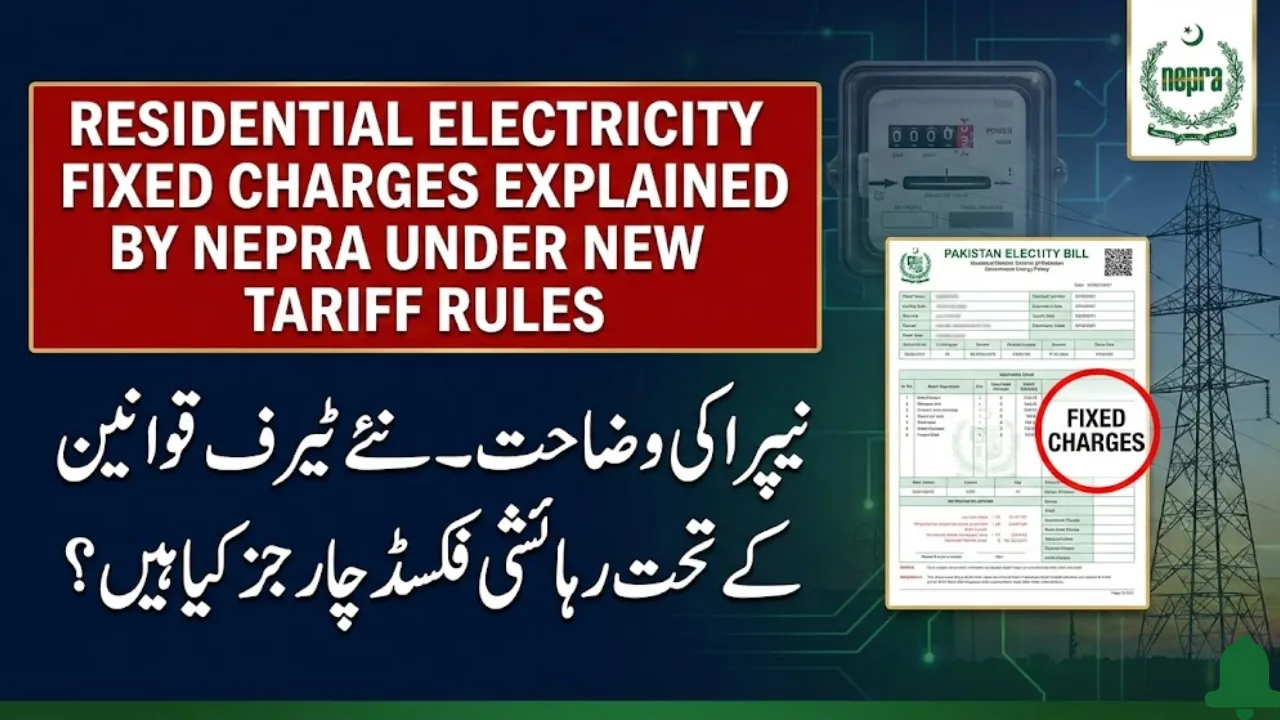
The National Electric Power Regulatory Authority has approved a major restructuring of residential electricity tariffs, introducing mandatory fixed monthly charges for domestic consumers across Pakistan. The decision applies to consumers of ex-WAPDA DISCOs and K-Electric, impacting more than 28 million households.
This marks a structural shift in how electricity bills are calculated in 2026. NEPRA has introduced fixed monthly electricity charges of Rs. 200 to Rs. 675 for residential consumers under the new tariff rules.
What Are Fixed Electricity Charges?
Under the revised tariff framework:
-
Consumers will now pay a fixed monthly amount, regardless of electricity usage.
-
This charge is separate from per-unit (kWh) consumption cost.
-
Even if usage decreases, the fixed charge will still apply.
The move is aimed at stabilizing revenue recovery for power distribution companies.
New Fixed Charges for Residential Consumers (2026)
Protected Consumers
| Monthly Usage |
Fixed Charge (PKR) |
| Up to 100 Units |
Rs. 200 |
| 101–200 Units |
Rs. 300 |
Non-Protected Consumers
| Monthly Usage |
Fixed Charge (PKR) |
| Up to 100 Units |
Rs. 275 |
| 101–200 Units |
Rs. 400 |
| 201–300 Units |
Rs. 550 |
| 301–400 Units |
Rs. 600 |
| 401–500 Units |
Rs. 650 |
| Above 600 Units |
Rs. 675 |
Lifeline consumers (very low usage households) remain exempt from fixed charges.
Why NEPRA Introduced Fixed Billing
According to regulatory officials, the decision addresses:
-
Rising fixed system costs
-
Capacity payments to power producers
-
Transmission and distribution maintenance expenses
-
Declining electricity sales due to energy efficiency and solar adoption
The regulator estimates the new structure may generate approximately Rs. 101 billion annually to support system stability.
How This Impacts Household Bills
Under the previous model:
Under the new structure:
This could particularly affect:
Shift in Pakistan’s Electricity Pricing Model
The introduction of fixed charges signals a broader transformation:
-
Revenue recovery is now partly independent of consumption.
-
Power companies secure predictable monthly income.
-
Consumer behavior may gradually shift toward off-grid or battery storage solutions.
Industry analysts describe this as a long-term structural adjustment rather than a temporary measure.
Common Questions About New Fixed Charges
What is the maximum fixed electricity charge in 2026?
Rs. 675 per month for consumers using more than 600 units.
Are lifeline consumers affected?
No, lifeline consumers remain exempt.
Will my bill increase even if I use less electricity?
Yes, the fixed charge will apply regardless of reduced usage.
Why did NEPRA introduce fixed charges?
To stabilize revenue recovery and cover rising fixed system costs.
Does this apply to all cities?
Yes, it applies to ex-WAPDA DISCOs and K-Electric consumers nationwide.
Conclusion
NEPRA’s decision to implement fixed monthly electricity charges represents a fundamental change in Pakistan’s power tariff structure. While the move aims to ensure financial sustainability of the electricity system, it also introduces new financial considerations for households. Consumers will now need to factor in mandatory fixed charges when managing monthly electricity expenses in 2026.